
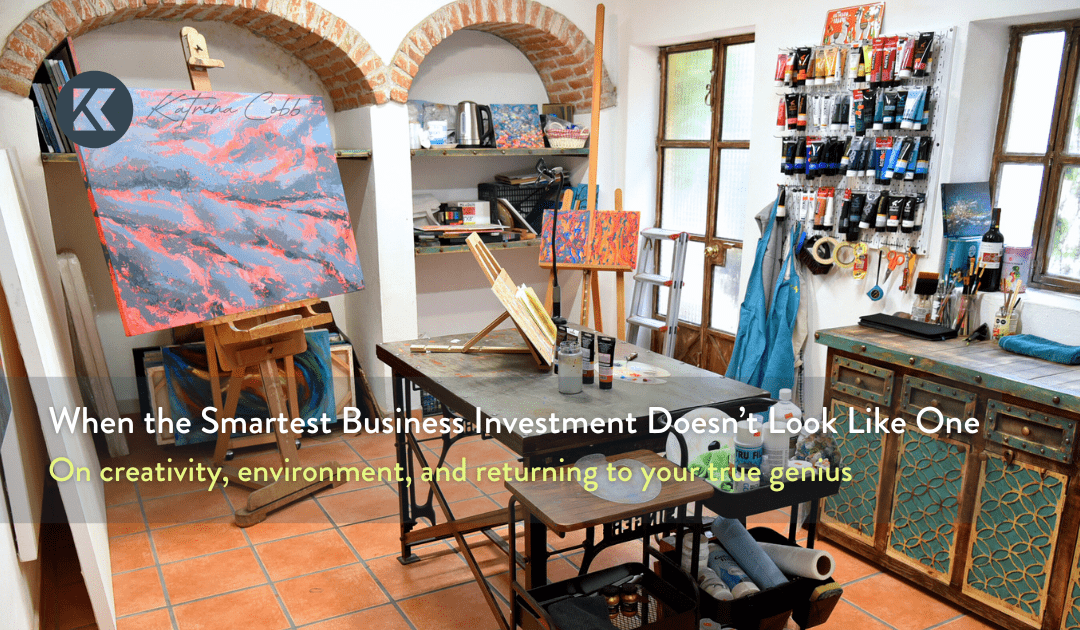
On creativity, environment, and returning to your true genius
Truth: The investment that didn’t make sense on paper
At the beginning of this year, I made a business decision that didn’t look like a business decision at all.
I rented an art studio.
It cost about $400 a month.
It didn’t come with a clear revenue model.
It didn’t slot neatly into a spreadsheet or a quarterly growth plan.
And yet, looking back, it may have been one of the most strategically impactful investments I made all year.
Not because it generated immediate income.
But because it changed the conditions under which every other decision was made.
This is a story about creativity, yes, but more importantly, it’s a story about environment, identity, and the kinds of investments that quietly unlock clarity, confidence, and sustainable growth, especially in midlife.
Why midlife women in business need a different kind of strategy
The women I work with are not beginners.
They’ve built successful businesses.
They’ve made good money.
They know how to execute.
And yet, many of them arrive at a similar crossroads in midlife:
- The business works, but feels heavy
- The pace that once felt energizing now feels depleting
- There’s a craving for reinvention, or at least recalibration
- And an unspoken question: Is this really how I want to operate for the next 10–20 years?
The instinct is often to look for a new strategy, a new offer, a new system.
But in my experience, the issue is rarely tactical.
It’s environmental.
It’s nervous-system based.
It’s identity-based.
And that’s where my own year began.
The studio as an environmental and identity investment
When I rented my studio, I wasn’t trying to “become an artist” in a branding sense.
I was creating a boundary.
A physical space where I could:
- think without interruption
- work without squeezing myself into the margins of daily life
- and engage with creativity without pressure to monetize or optimize it
That space quickly became a refuge, not just for art, but for clarity.
Here’s what surprised me:
Once my nervous system had somewhere to land, everything else started to reorganize.
Ideas surfaced without forcing.
Decisions felt cleaner.
I could see patterns instead of reacting to noise.
This is something we intellectually understand but rarely design for:
Your environment is not neutral. It is constantly shaping your thinking, energy, and decision-making.
And yet, most founders only invest in environments that are “justifiable” on paper — software, consultants, ads — while neglecting the spaces that actually determine how well they function.
Creativity as a strategic processing tool (not a distraction)
For me, creativity isn’t about output; it’s about processing.
Being in the studio put me into a state similar to long walks, showers, or moments of deep presence:
- hands occupied
- mind relaxed
- pressure removed
In that state, my brain did what it does best: connect dots.
While painting, I found myself clarifying:
- what mattered now (and what no longer did)
- where my energy was naturally flowing
- what kinds of problems people consistently came to me for
This is something many founders miss:
Creativity doesn’t pull you away from strategy.
It creates the space in which strategy becomes obvious.
By reconnecting with myself creatively, I could see my business more clearly, not as something to reinvent, but something to realign.
The slow return to what I’m actually a genius at
Midway through the year, my life context expanded.
My partner was navigating entrepreneurship.
My stepdaughter was preparing for university.
Family priorities were shifting.
None of this felt like a crisis… but it did feel like a moment of truth.
As I explored lifestyle design more deeply, I noticed something important:
People weren’t coming to me for inspiration alone.
They weren’t asking me to hold space.
They wanted business architecture.
Clear strategy.
Grounded decision-making.
And here’s the part that matters:
Instead of forcing myself into a broader or more “holistic” identity, I chose to stand in my actual genius.
Creativity didn’t pull me away from business.
It helped me accept where my impact truly lies.
That acceptance was a form of permission I didn’t realize I needed.
Rethinking ROI: What thriving actually requires
From the outside, renting a studio doesn’t look like a smart growth move.
But when you zoom out, the returns were undeniable:
- clearer thinking
- steadier energy
- better decisions
- stronger relationships
- deeper confidence in my direction
None of those show up neatly on a P&L, but they compound.
This is the conversation I wish more women founders were having:
Not every high-ROI investment looks like a business expense.
Some of the most powerful ones change your daily experience.
Your space.
Your rhythm.
Your identity.
Your sense of self-trust.
Those are not luxuries. They are infrastructure.
What I want other women founders to hear
If you’re in midlife and feeling the pull toward something different, but unsure where to start, consider this:
You don’t need permission to invest in what helps you thrive.
You don’t need to justify every decision in advance.
And you don’t need to make yourself wrong for shifting focus as your life evolves.
Sometimes the most strategic move is not doing more, but designing better conditions.
Conditions where clarity emerges.
Where creativity and strategy coexist.
Where you’re no longer forcing yourself into boxes that no longer fit.
That’s not a detour from growth.
That is growth, just at a more intelligent level.
Katrina Cobb is a Business Architect for high-achieving women founders scaling beyond $250K. She helps leaders redesign the architecture of their business — systems, structure, team, and profitability — so growth feels spacious, sustainable, and deeply aligned.
Explore her work at katrinacobb.com.