
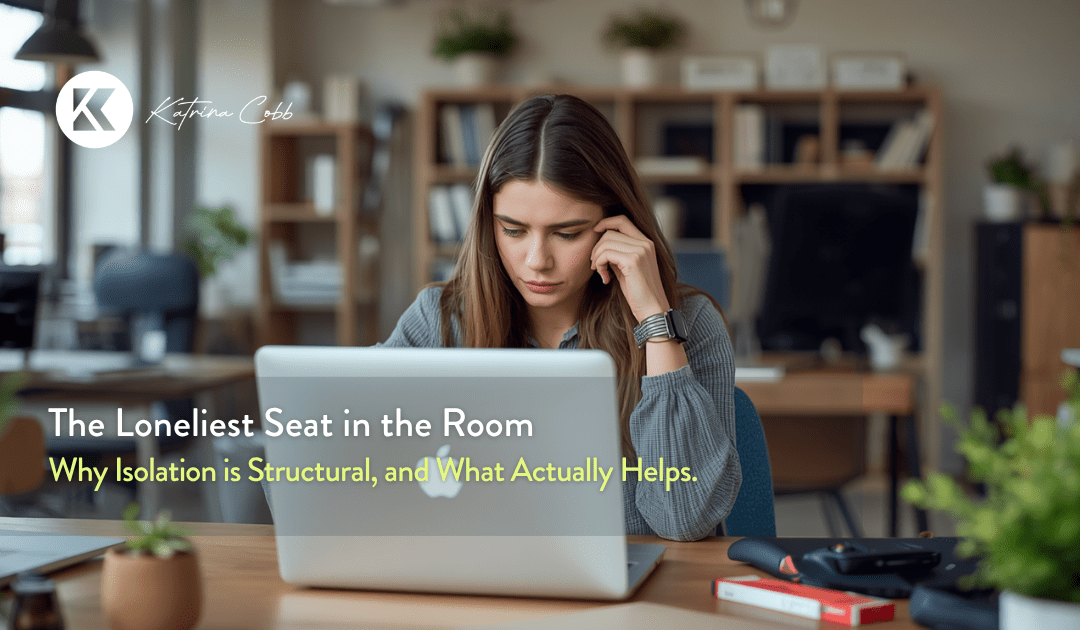
There’s a specific kind of loneliness that doesn’t look like loneliness from the outside.
It looks like a busy schedule. A full team. A business that’s growing. A life that, by most measures, is working. But inside… it’s quiet in a way that doesn’t feel like peace. It feels like carrying something too heavy, alone, for too long.
If you’ve built a business past $300K, you know this feeling. And you probably don’t talk about it much.
The Room That Gets Smaller as You Grow
There’s a strange thing that happens when your business reaches a certain level. The conversations that used to feel energizing start to feel… off. Not because the people around you aren’t good people. But because they’re not in the same room you’re in anymore.
Your friends from college have jobs with clear boundaries: a start time, an end time, a paycheck that arrives whether or not the week was hard. They care about you. They just don’t have a reference point for what it means to run a team through a quarter where everything went sideways, miss your own child’s event because a client situation needed you, and then smile through it because you’re the one who’s supposed to have it together.
Your neighbors might not work at all, or they work in industries that bear no resemblance to yours. Your team sees part of the picture, but you’re their leader. You can’t show them the whole thing.
So you carry it.
The seat at the top of the table is also the loneliest seat in the room. And nobody tells you that when you’re building toward it.
It’s Not Just Personal. It’s Structural.
I want to be direct about something: this loneliness isn’t a personality issue. It’s not a sign that something is wrong with you, or that you should just “find your tribe” like a motivational poster suggests.
It’s structural. And it’s more common for women than the business world acknowledges.
There are simply fewer of us at this level. A very small percentage of all women-owned businesses ever reach sustained revenue above $300K. The ones that do often find themselves in spaces built for people at different stages. There’s a tremendous amount of noise for founders trying to hit their first $10K month, their first six-figure year. There’s a loud, persistent pressure to scale, to grow, to add a zero. But the middle… the woman who has built something real and is trying to figure out what kind of business she actually wants… that conversation is harder to find.
We’ve also been conditioned, quietly and over a long time, not to talk about money and success the same way men do. We don’t brag as easily. We don’t form these circles overtly. The peer groups that could hold us aren’t as visible, so they feel harder to find. And in the absence of finding them, we conclude, wrongly, that they don’t exist.
They do exist. They’re just not forming on their own.
The Season Makes It Heavier
I’m writing this in April. Tax season is wrapping up. You’ve probably just finished business taxes and are now managing personal taxes on top of them. Spring break either just happened or is about to, which means you coordinated school schedules, childcare, your own work calendar, and someone else’s peace of mind simultaneously.
The business is in a growth season, which means more decisions, more pressure, more to hold. But you’re still responsible for holding the rest of it too: the household, the invisible logistics, the emotional load that doesn’t have a line item anywhere.
And you’re not dumping this on your team. Because you’re the leader. Because that’s not what leaders do.
So it sits with you.
This is the part of entrepreneurship that nobody puts in the case study.
What Women at This Level Actually Need
I’ve had the business conversations. I’ve done the strategy. I’ve helped women redesign their operations, their offers, their pricing. And what I’ve noticed, consistently, is that the strategy lands differently when a woman isn’t operating from isolation.
When she has a room… even a small one… of people who get it. People she can say the actual thing to, not the polished version.
We don’t need more information. We need people who understand what it means to hold all of this. People we can ask: “Am I being crazy, or is this actually as complicated as it feels?” and get an honest answer from someone who’s in the same fog.
I know this because I’ve lived it.
I moved to Mexico several years ago. I’ve built my business from here as a nomad, as an American woman, in a city that is primarily retirees. There is no natural peer group for what I’m doing here. I’ve looked. And the absence of it, the specific absence of women at a similar level who are navigating similar things, has been a real lack. Not a small one.
So I started building it.
I connected with one other coach here who was craving the same thing. We put out a specific invite, and a handful of women showed up. Business owners who aren’t here full time, but some are. Women doing interesting, serious work, who were just relieved to be in a room where they didn’t have to explain themselves. The first meeting we had was one of the best business conversations I’ve had in years. We’re doing more.
I’ve also been fortunate to have an accountability group I was placed in by my own coach about four years ago, when she went on maternity leave. Three of us. We meet every two weeks. We’ve been doing it for four years because the value hasn’t stopped. There are conversations I have in that group that I cannot have anywhere else: about money, about doubt, about decisions, about the moments where you’re not sure you’re doing this right. We can say the real thing. And that changes everything.
Why This Matters More Than the Strategy
Here’s what I’ve learned from the women I work with: the loneliness isn’t just uncomfortable. It’s a performance drag.
When you’re isolated, you stay stuck in your own head longer. The imposter syndrome runs louder because there’s no outside voice offering perspective. You second-guess decisions more because there’s no one to reality-check with. You undercharge, over-deliver, and stay too long in situations that aren’t working because you don’t have enough external signal that you’re allowed to make a different choice.
The peer room, the one with other women at your level who are working through the same kinds of problems, isn’t a nice-to-have. It’s part of the architecture of a business that actually works.
Successful businesses are not built by one person carrying everything perpetually. We know this. The same is true in our personal lives: we thrive with close circles, people we can confide in, people we can grow with and be honest with. Business is no different. But those circles are harder to find at this level. And because they’re harder to find, women often go without them longer than they should.
The scale and scale messaging won’t fill this gap. A bigger team won’t fill this gap. Another strategy session won’t fill this gap.
A room of women who understand exactly what you’re carrying might.
What I’m Building (and Why)
This is part of why I’m opening the Business Architecture Mastermind.
Not instead of private mentoring. That’s still here. But alongside it, because I’ve recognized that the room itself is often the most valuable thing I can offer.
The mastermind is built for women running $300K and beyond who want a business that works better: more spacious, less founder-dependent, more aligned with the life they actually want to be living. We work on the structure, the systems, the capacity, the real things blocking freedom.
But the community piece, having a group of women at the same place, working on the same kinds of things, who are in a group chat on your phone for when something comes up or you just need someone to hear you, is the part I think people underestimate. Until they’re in it.
It’s often what makes all the other work feel lighter.
If any of this has landed for you, if you’ve been feeling the weight of carrying it mostly alone, I’d love for you to sit in the room with us. I have a guest pass available for an upcoming training where we’re going to look directly at what’s blocking time and energy for women at this stage, and start working on it together.
No pressure. Just a seat in a room where you don’t have to explain yourself.
Katrina Cobb is a Business Architect for high-achieving women founders scaling beyond $300K. She helps leaders redesign the architecture of their business — systems, structure, team, and profitability — so growth feels spacious, sustainable, and deeply aligned.
Explore her work at katrinacobb.com.