

There is a meme going around.
You have probably seen it. Maybe shared it.
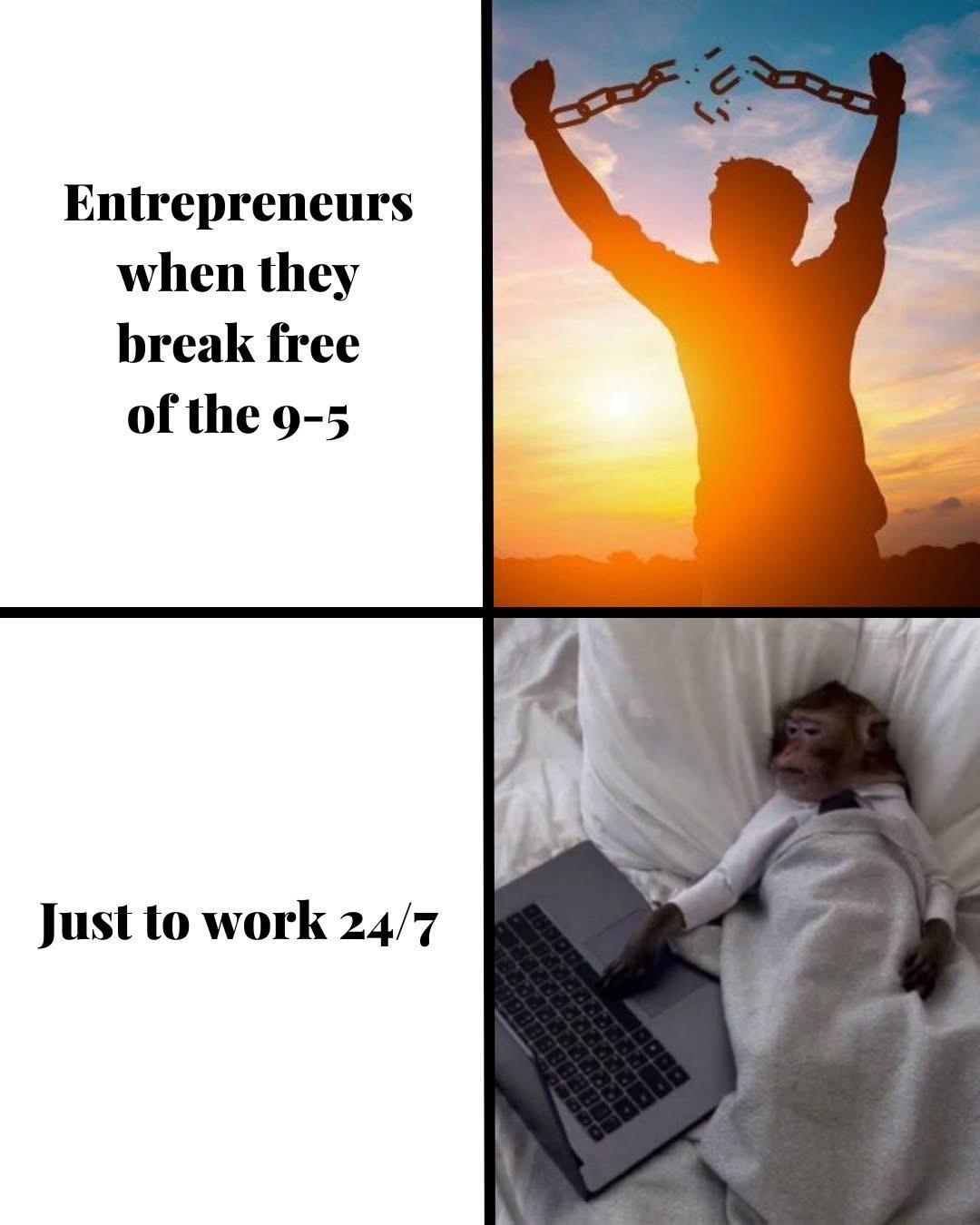
Top panel: an employee shattering chains, triumphant, backlit by a sunset. It says ‘you finally left your 9-5…’
Bottom panel: a monkey in a suit, slumped in bed with a laptop at midnight.
The caption says “just to work 24/7.”
Everyone laughs. Tags their founder friends. Posts it in group chats.
I am not laughing.
Not because I don’t have a sense of humor. Because I’ve watched that meme get shared by women who are quietly using it to normalize something that is not okay. They’re laughing so they don’t have to say out loud: “This is my life and I don’t know how to get out of it.”
That second panel is not a rite of passage. It is a design problem.
And design problems have design solutions.
Why the Meme Keeps Landing
The reason this meme spreads is not because it’s funny. It’s because it’s true for a lot of people, and they don’t have a different frame for it yet.
The story most founders absorbed goes something like this: working for yourself means freedom in theory, but hustle in practice. The 9-to-5 prison swaps for a 24/7 self-imposed one. The difference is that this time, at least it’s yours.
That story is everywhere. It’s in the culture, in Hollywood representation, in the podcasts, in the offhand comments of other founders who are also living it. And when something is everywhere, it starts to feel like truth.
But here is what I know from working inside real businesses with real women building real revenue:
The always-on founder is not a personality type. It is a structural outcome.
What “Always On” Is Actually Telling You
When a founder cannot take three weeks in India without her business becoming a crisis, that is information.
When she checks email on vacation and tells herself it’s just this once, that is information.
When she says “my team is great” and means it, but still can’t step back without things wobbling, that is information too.
None of it means she isn’t smart enough, driven enough, or capable enough. It means her business was built around her presence as a load-bearing wall. Remove the wall and the whole structure shifts.
That’s not a mindset problem. That’s an architecture problem.
And the difference matters, because mindset fixes point inward. Architecture fixes point at the structure. One asks you to become someone different. The other asks you to build something different.
The founders I work with are not failing at discipline or boundaries. They are operating inside structures that were never designed to run without them.
What Is Actually Possible
I want to be specific here, because I am not interested in selling you a vision.
One of my clients just returned from three weeks in India. Her business ran. Another is in Costa Rica right now on vacation with her son. It is not a workcation. Another is taking her whole family to Greece for two weeks next month, funded by her profits.
All three run seven-figure businesses.
None of them are checking in every hour. None of them came back to a pile of disasters.
I built my own business around painting time, travel, and a life in San Miguel de Allende. I have crossed $700K in revenue doing it this way. Not despite how I live, but because of how I built.
So when I say freedom is possible, I am not offering you inspiration. I am offering you evidence.
The Structural Fix
The bottleneck is rarely what founders think it is.
Most assume the problem is time management. Or delegation. Or finding better people. So they get a project manager. They build better to-do lists. They take a productivity course.
And it helps, a little, for a while.
What doesn’t change: the fact that the business is still routing everything important through the founder. Her judgment. Her approval. Her presence. Her energy.
That is the actual bottleneck.
Business architecture, in the simplest terms, means designing the structure of your business so it can hold decisions, maintain quality, and generate revenue without requiring the founder to be the nervous system of all of it.
It is not glamorous work. It does not make for a good Instagram reel. But it is the work that makes three weeks in India possible. It is the work that means you can sleep through the night without half your brain still running payroll math.
It is the difference between a business you run and a business that runs.
The Question Worth Sitting With
If you saw yourself in that meme and felt something heavier than amusement, pay attention to that.
The laugh is real. But underneath it, there is often a quieter belief: “This is just how it is for me specifically. My business is too dependent on me. My clients need me available. My team isn’t ready.”
That belief deserves examination.
Not because it’s wrong to notice those things. But because what sounds like a permanent reality is often a structural condition. One that can be changed, methodically, without blowing up what’s working.
You did not build a $300K or $500K business because you were careless. You built it because you are capable, resourceful, and relentless. But those same traits can build a structure that depends too heavily on you, and then quietly trap you in it.
That’s not a flaw. It is a very predictable outcome of building without a blueprint that accounts for your eventual exit from the center.
The question is not whether it’s possible to change. It is whether you are ready to stop treating the midnight laptop as a given.
If you are running a mid-six-figure business and you cannot remember your last real vacation, the Bottleneck Breakthrough Event is for you. It is a free, three-hour virtual working session. We will map the specific places your business depends on your presence and start building the structural changes that return your hours to you.
This is not a traditional webinar or pitchfest. It is a working session. Come ready to look at your business clearly and actually redesign a piece of it that has been bogging you down, live with support.
Register here for the Bottleneck Breakthrough Event
Katrina Cobb is a Business Architect for high-achieving women founders scaling beyond $250K. She helps leaders redesign the architecture of their business — systems, structure, team, and profitability — so growth feels spacious, sustainable, and deeply aligned.
Explore her work at katrinacobb.com.