
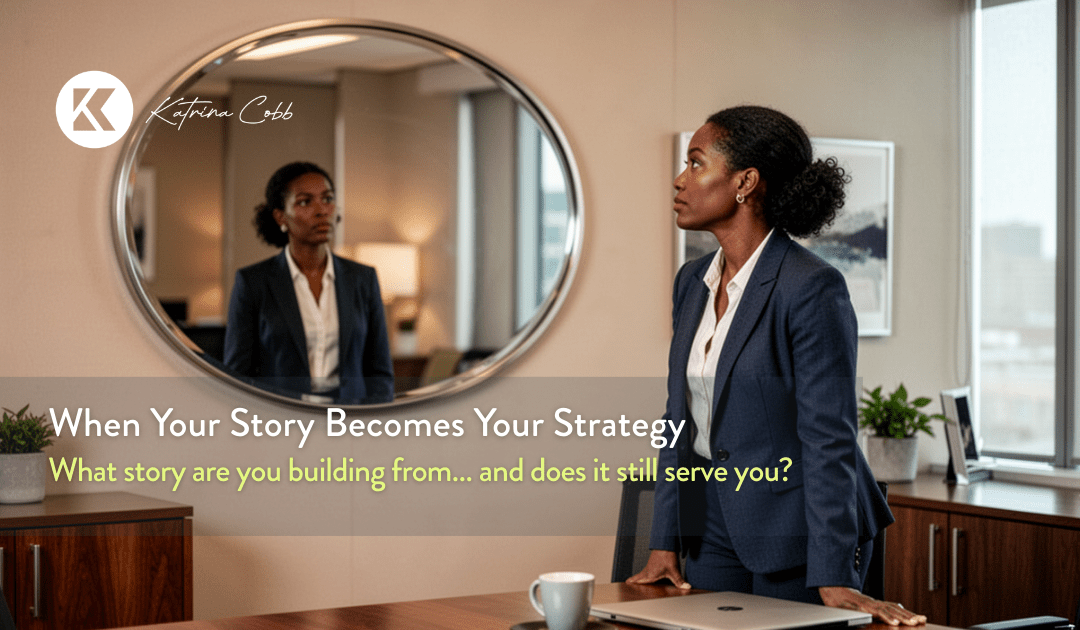
There is a moment in many conversations with founders where the strategy stops being the interesting part.
We can talk about systems.
We can talk about team structure.
We can talk about workflows, SOPs, delegation, decision rights.
All of that is solvable.
What becomes harder is something quieter.
The story running underneath the business.
Because at some point, the story you tell about your business quietly becomes the way you run it.
It becomes your strategy.
The Story That Sounds Like Reality
I hear the same phrases in different forms almost every week.
“It’s just not realistic for me to take time off right now.”
“My business really does need me.”
“Things fall apart if I’m not involved.”
“I wish I could do what you do, but my business is different.”
When someone says this, I’m rarely hearing a logistical problem.
I’m hearing a story.
A story that once made perfect sense.
A story that was probably true once.
And a story that may still be quietly running the show.
The Founder Who Cannot Leave
Not long ago I was speaking with a client who had been in business for years. Strong revenue. A capable team. Good systems already in place.
When the topic of taking extended time away came up, she immediately laughed.
“That’s not realistic for me.”
When I asked why, she began listing the reasons.
Clients expect her.
Her team needs guidance.
Important decisions always come to her.
Things would slow down without her.
Then she paused and said something interesting.
“I’m just the one who keeps everything moving.”
That sentence held more truth than she realized.
Not because it was objectively true.
But because it had become her identity.
For years she had been the one holding things together. The one solving problems. The one who could jump in anywhere when something broke.
And that story had worked.
It helped her build the business.
But now it had quietly become the strategy.
Every decision rolled to her.
Every escalation landed on her desk.
Every unresolved question waited for her approval.
Not because the team was incapable.
Because the system had been built around the belief that she must always be needed.
The Story We Carry Forward
Most founders do not consciously choose this.
The story forms early.
In the beginning stages of a business, it is often true.
You are the marketer.
The operator.
The strategist.
The customer service department.
You are the one who fixes things when they break.
And because you can… you do.
Over time that ability becomes something else.
Proof of value.
Proof of dedication.
Proof that the business works because of you.
The story becomes familiar.
“I’m the one who keeps this running.”
And familiarity can be deceptive.
Because what once described reality begins to shape it.
When the Story Becomes the Strategy
When a story becomes your strategy, you stop questioning it.
You build systems that reinforce it.
You design processes where decisions escalate to you.
You hire people who defer to you.
You unconsciously position yourself as the safety net for every possible scenario.
And eventually, you look at the structure around you and say:
“See? It has to be this way.”
But the structure is not proof.
The structure is the result.
The Moment That Changes the Question
Sometimes the shift begins with a different question.
Not:
“Can I take a month off?”
But:
“What would have to be true for me to take a month off?”
When founders start answering that question, something interesting happens.
The answers are rarely impossible.
“I would need clearer processes.”
“My team would need decision boundaries.”
“I would need marketing running consistently.”
“I would need someone to handle internal issues while I’m gone.”
None of these are fantasies.
They are design problems.
Which means they are solvable.
But solving them requires confronting the story underneath.
The Story That Protects Us
Stories are not always wrong.
Sometimes they are protective.
They keep us from risking disappointment.
If I believe the business cannot function without me, then I never have to test whether that is true.
I never have to risk someone dropping the ball.
I never have to feel the discomfort of letting someone else carry responsibility.
Remaining indispensable feels safer.
Even when it is exhausting.
The Subtle Cost
The cost of this story is rarely obvious at first.
The business grows.
Revenue increases.
Clients are happy.
But slowly something else appears.
You cannot step away.
Your nervous system is always engaged.
Vacations are partial at best.
Your presence becomes the stabilizing force for everything.
And the longer the story runs, the more convincing it becomes.
“This is just what it takes.”
The Question Worth Asking
Every founder eventually reaches a moment where the story deserves examination.
Not with judgment.
With curiosity.
What story am I carrying about how this business works?
And more importantly:
Does that story still serve the life I say I want?
Because the truth is this.
Your story will shape your systems.
Your systems will shape your time.
Your time will shape your life.
If the story says you must always be present, the structure will guarantee it.
If the story allows the business to carry weight without you, the structure will evolve in that direction.
Neither happens by accident.
A Different Possibility
The founders who eventually step away for weeks at a time did not start there.
They started with the same stories.
The difference is that at some point, they allowed themselves to question them.
Not dramatically.
Just enough to ask:
What if that story is no longer true?
What if the business I built could actually hold more than I think?
What if the next stage of leadership is not doing more, but designing differently?
When that question appears, strategy changes.
Not because the founder became less committed.
Because she became more intentional.
So Here Is the Real Question
Not whether you can take time away.
Not whether your team is ready.
Not whether the systems exist yet.
The real question is quieter.
What story about your business has quietly become your strategy?
And if that story no longer leads where you want to go…
What story would serve you better?
Katrina Cobb is a Business Architect for high-achieving women founders scaling beyond $250K. She helps leaders redesign the architecture of their business — systems, structure, team, and profitability — so growth feels spacious, sustainable, and deeply aligned.
Explore her work at katrinacobb.com.