
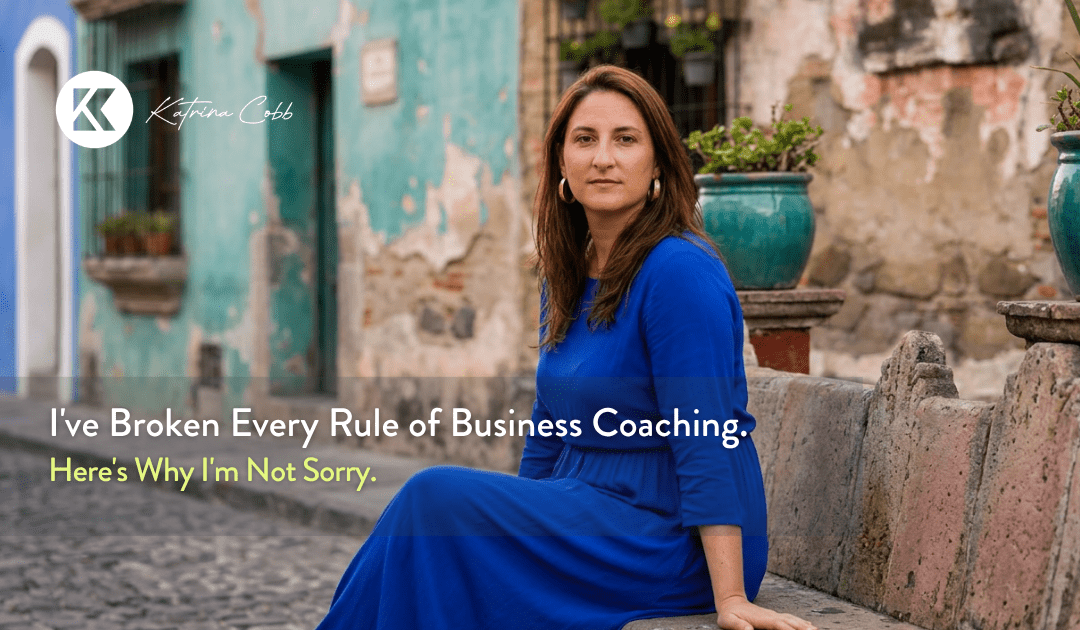
There is a rule in the coaching world that says you should stay in your lane.
Pick one thing. Become the expert in that one thing. Build your offer around that one thing. Set clear boundaries around your scope of work. Stay there.
I understand why the rule exists. I just don’t follow it. And after watching what happens to clients when their support is too narrow, I’ve stopped apologizing for that.
The Time I Did Everything Right and Lost Everything That Mattered
Early in my career, I had mentors who were good at what they did.
They had frameworks. They had data. They had a clear path to growth. And I followed that path. I opened a second location. I hit the revenue targets. I executed the plan.
By every measurable business metric, I was succeeding.
What those mentors never asked about was the rest of my life. My energy. My relationships. My capacity to actually sustain what I had built. Those variables were outside the scope.
And here is what happened: I stretched across two businesses that were both competing for my attention. Staffing at the second location was harder than anyone had modeled for. Marketing two locations at once was harder. My personal health quietly deteriorated. I had no time for anything that actually mattered outside of work. And I lost a relationship because I simply was not available. I was building for a version of success that had been handed to me, not designed by me.
I had followed the plan. I had grown the business. I had broken myself doing it.
That experience did not make me distrust strategy. It made me distrust strategy that ignores context.
What Architecture Actually Taught Me About Business
Most people are surprised to learn I studied architecture before I became a business advisor. And not just the design of buildings. Actual architecture: structures, engineering, geology, environmental systems, regional climate conditions, material science, airflow, solar orientation.
The thing about architecture that doesn’t get talked about enough is this: there is no universal building.
What you build in the Swiss Alps looks nothing like what you build in the Sonoran Desert. And not because of aesthetics. Because of physics.
In the American Southwest, you face windows north to flood a space with natural light without the heat gain of southern exposure. You build with thick walls that hold the cool of the night and release it slowly through the day. Adobe architecture is not a style choice. It is a direct response to climate, material availability, solar patterns, and the specific demands of that environment.
Take that same building to Switzerland and it fails. Not because the design is bad. Because the context is completely different.
I kept waiting for someone in the business world to make this point, and nobody was making it. So eventually I started making it myself.
The Copy-Paste Problem in Coaching
Here is what I see happening in the coaching industry at scale, and it’s the thing that bothers me most.
A coach has success. Real success. She grows to seven or eight figures doing something a specific way, in a specific business model, with a specific type of client, in a specific season of her business and her life. Then she packages what worked for her and teaches it.
And the problem is not the packaging. The problem is the implicit promise underneath it: this will work for you too.
What that framing ignores is everything that made it work for her. Her location. Her industry. Her existing audience. Her personal financial situation. Her team. Her life stage. Her specific combination of strengths and constraints. The hidden context that made her particular desert building perform so well in its particular desert.
When you take that building and plant it somewhere else without accounting for the new climate, you get something that looks right but performs wrong. And that is exactly what I see women experiencing when they walk away from a coaching program that should have worked, that had all the right pieces, and yet somehow didn’t translate into their life.
It is not that they failed to execute. It is that the architecture was designed for someone else’s site.
What I Actually Look At When I Work With a Client
My architecture training is not a metaphor I reach for because it sounds good in a bio. It is genuinely how I was taught to see.
An architect does not look at one system and ignore the rest. She holds all of it at once. Because a building that has a beautiful structure but ignores how the sun moves through it, or how the people inside it actually want to live, is not a successful building. It is just an expensive one.
I do the same thing with a business.
When I sit with a client, yes, I am looking at the revenue. But I am also looking at who she is becoming in the process of growing it. Whether the pace she is keeping is actually sustainable for her specific body, her specific season of life, her specific relationships. Whether the team she is building reflects what she actually needs, or what she thinks she is supposed to need at this stage.
A client comes to me because her business is doing well and she is exhausted. That sounds like an operations problem. Sometimes it is. But just as often, it is a values problem. She has been optimizing for the wrong metric because nobody ever asked her what she actually wanted the business to give her.
Another client is struggling to delegate. Coaches tell her she needs better systems. Maybe. But what I often find underneath is that she does not yet trust herself to lead from a distance. That is not a systems problem. That is an identity problem. And no org chart fixes it.
A third client is hitting revenue goals and feeling nothing. Her coach celebrates the numbers. I ask what she is not saying.
This is not therapy. It is architecture. It is the practice of looking at the whole structure, including the parts that are not visible from the outside, before recommending what to build next.
What the Rules of Coaching Get Wrong
The rules say: set boundaries. Stay in your lane. Define your scope.
I understand those rules exist to protect the coach from overextension and the client from confusion. But I also think they do something else, something less intentional: they give coaches permission to stop looking.
Stop looking at the relationship strain underneath the revenue goal. Stop looking at the health situation that is quietly affecting her decision-making. Stop looking at the financial fear that is making her underprice everything. Stop looking at the life stage shift, the new baby, the aging parent, the cross-country move, that is reshaping what she actually needs her business to do.
When a coach draws a tight box around her scope of work, she is often drawing a box around the very context that explains why the strategy is not landing.
I have watched women leave coaching programs with beautiful frameworks they could not implement, not because they lacked discipline, but because nobody accounted for the actual climate of their life. The kids. The health issue they mentioned once and nobody followed up on. The partnership that was quietly fracturing. The grief they were still carrying.
Those are not soft variables. They are load-bearing walls.
Ignore them and the structure fails. Not dramatically, usually. Just slowly, in ways that are hard to name. The founder who cannot seem to get traction. The business that keeps almost working. The woman who keeps wondering why she still feels stuck when by every external measure she should feel free.
What This Means for the Women I Work With
I work with a very small number of clients at any given time. This is by design.
What I am describing is not a program. It is not a curriculum. It is not a framework I built for myself and am now teaching to a room full of women in different cities with different businesses and different lives and telling them it will work the same way.
It is a partnership. One where I am actually looking at your specific situation: the business you have built, the life you are trying to live inside it, the gap between those two things, and what it would actually take to close it.
Sometimes that means reworking your offer structure. Sometimes it means having a conversation about how you are making decisions under pressure. Sometimes it means asking the question your other advisors have not asked, not because they are not skilled, but because it was outside their lane.
Nothing is outside mine.
The rule-breaking is not the point. Designing something that actually works for you, for your life, in your specific context, is the point.
The rules just get in the way of that sometimes.
If you are at a stage where you need someone who can see the whole picture, and you want to explore what that kind of partnership looks like, you can inquire about availability at calendly.com/katrinacobb/business-diagnostic.
Katrina Cobb is a Business Architect for high-achieving women founders scaling beyond $300K. She helps leaders redesign the architecture of their business, lifestyle, leadership, and identity so growth feels spacious, sustainable, and deeply aligned with the life they actually want. Explore her work at katrinacobb.com.