
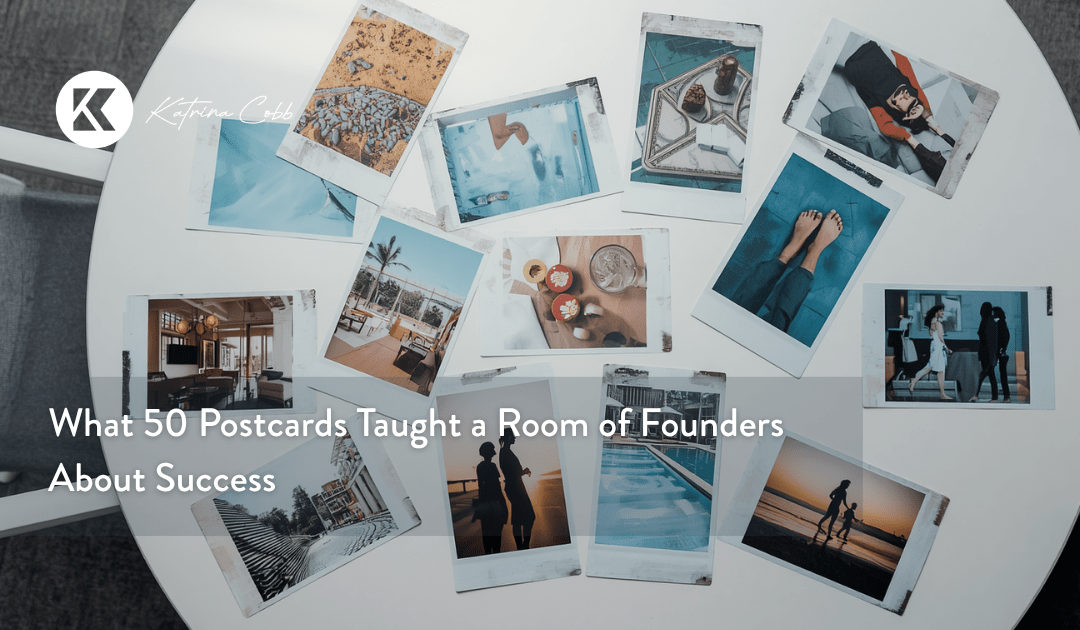
You see a photo. A woman with her feet in a pool, a paperback open on her lap, nothing in her hands but a cold drink. For half a second, you want that so badly it surprises you.
Then the second half of the second arrives. You think about who would cover for you. What would pile up while you were gone. What it would mean if the business kept going just fine without you in it.
So you keep scrolling.
I watched this exact moment happen, in slow motion, with fifteen women at a summit in France a few weeks ago. Except instead of a phone screen, it was a deck of fifty postcards spread across the floor.
The Question Behind the Exercise
I run an exercise with images. About fifty of them, all kinds: money, success, work, travel, art, stillness, relationships, things that don’t seem to belong in a business workshop at all.
I ask one question. Which of these shows the life you actually want?
Before I get into what happened, here’s why I use pictures instead of words. When I surveyed the room, about half the women said they think in images easily. The other half think in language and ideas, not pictures. That second half is often where the most useful answers come from, because when you hand someone an image instead of asking them to describe their goals out loud, you get past the answer they’ve practiced. The picture gets to something underneath the language.
What the Room Reached For
Almost nobody reached for the money images. A few did, and that’s normal. Money matters, and wanting more of it isn’t a problem.
But the vast majority reached for something else entirely. Travel. Creative work. Time with people they love. And a lot of images of doing absolutely nothing. A spa day. A woman by a fireplace with a novel. An empty afternoon with no plan.
These are accomplished women. Real businesses, real revenue, real teams. And what they were drawn to had almost nothing to do with the businesses they’d spent years building.
The Belief Hiding Behind “I Don’t Have That Yet”
Once everyone had their postcards, we went deeper. For each one, I asked the same question. What is this picture actually giving you? If it’s a photo of travel, is the real thing underneath it freedom? If it’s a photo of a relationship, is it connection, or something more specific, like being fully present with someone instead of half there?
This is where it stopped being a fun exercise and started being useful, because the next question is the one that actually changes things. If this is what you want, why don’t you have it yet?
One example stayed with me. Several women said what they wanted most was real travel. Not a long weekend with a laptop open the whole time. Actual weeks away.
When we got into why that wasn’t already part of their lives, the answer wasn’t logistics. It was a belief. Somewhere along the way, each of them had absorbed the idea that being a successful entrepreneur means being needed. If the business runs fine without you, what does that say about your value? What’s left to prove?
Another version of the same fear showed up around relationships. A few women picked images that pointed to connection, partnership, time with people who matter. And underneath that was a quiet worry that having real freedom, a thriving business, and a full personal life all at once just isn’t realistic. That something always has to be traded.
None of these are facts. They’re beliefs, and beliefs can be examined.
A New Definition of Success
So I asked the room to try on a different definition of success. Not “I built a business that needs me for everything.” Instead:
I built a business so well designed, so systemized, with a team I trust, that it delivers great results whether I’m in the office or not. It’s booked out a year in advance. And I just took two months off.
Every woman in that room exhaled. Out loud. At the same time.
That’s not a coincidence. That’s what happens when you hear a version of success that’s actually allowed.
The Permission to Want Space
A second theme ran through almost every postcard that wasn’t about travel. Women reached for images of space. Sitting by a pool doing nothing. A walk with no destination. An afternoon with a novel and nowhere to be.
One woman, describing what she wanted, used the phrase “time to waste.” She said it almost apologetically, like she needed to justify it.
That phrase says a lot. Somewhere, most of us picked up the idea that unstructured time is wasted time, and that a responsible business owner doesn’t get to have it. Rest has to be earned, scheduled, or justified.
But people don’t run at full output all the time, and they’re not supposed to. The ideas that actually move a business forward usually show up in the space, not in the sprint. Wanting white space isn’t a flaw in your work ethic. It’s part of how the rest of it works.
Why It Doesn’t Have to Wait
Here’s the part that mattered most. For each woman, once she named what she wanted and what it really represented, the next step was naming what was actually in the way. And it was almost never logistics. It was a rule she’d been following without ever deciding to follow it. Inherited from family, from culture, from the books and the entrepreneurs who shaped how she thinks about work, and never questioned since.
Almost everyone had also placed what they wanted on the other side of some future milestone. After the next launch. After the next ten clients. After this year. Always after.
So I gave the room a different challenge. Not “design the dream life eventually,” but “find 5 percent more of it in the next 30 days.” Not the whole vision. Just a sliver of it, now.
Every single woman in that room found something. A boundary. A belief to test. A small change that made room, even a little, for the thing she said she actually wanted.
That’s the real gift of the exercise. Not the postcards themselves, but the clarity underneath them: what you want, what it actually represents, what’s been quietly holding it at arm’s length, and the fact that none of it has to wait for a milestone that keeps moving.
You’re one design decision away from a completely different experience. Not in some distant future. Now.
If this sparked something, you don’t need fifty postcards to start. Pick one image, one memory, or one moment that represents the life you actually want, and ask yourself honestly why it doesn’t feel present right now. The answer is usually a belief, not a logistics problem.
If you want a more structured starting point, my Freedom Audit is a quick way to see where time, energy, and freedom are quietly out of alignment in your business right now. And if you’d like to run a version of this exercise for yourself or your team, reach out. I’m happy to walk you through it.
Katrina Cobb is a Business Architect for women founders generating $300K to $1M+. She helps leaders redesign the architecture of their business, lifestyle, leadership, and identity so growth feels spacious, sustainable, and deeply aligned with the life they actually want. Explore her work at katrinacobb.com.